

Reconcile one outgoing ETH payment
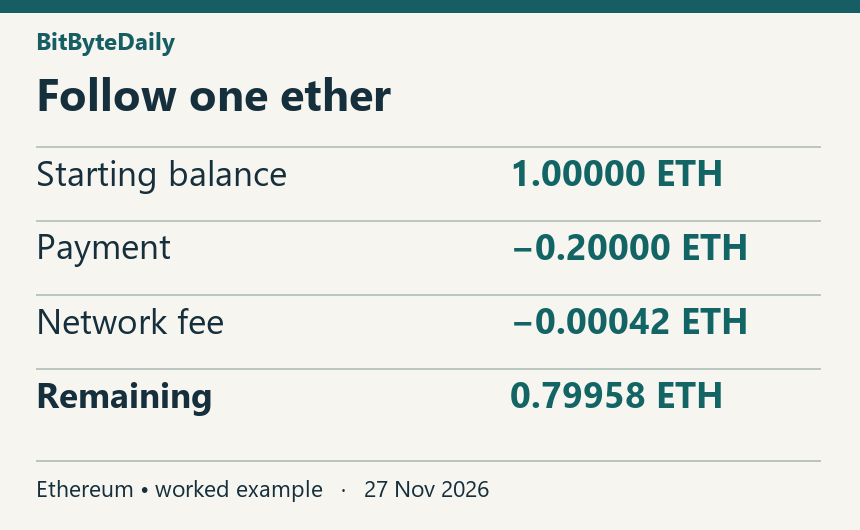
Imagine an Ethereum address starts with exactly 1 ETH. Its owner sends 0.20 ETH. The explorer lists a successful transfer and a transaction fee of 0.00042 ETH. With no other activity, the sender should have 0.79958 ETH left. The recipient receives 0.20 ETH. The fee is a separate debit from the sender.
If the tracker shows a different dollar balance tomorrow, first compare the number of ETH. A valuation can move while the coin balance stays still. If the ETH figure itself differs, compare the same network at the same time. If both tools offer historical balances, select the same block height. A screenshot from before a second withdrawal and a current address page describe different moments.
What the address history can actually establish
An address page collects activity. A transaction page narrows the question to one signed instruction and its outcome. For a token transfer, inspect the token movements and contract address rather than reading only the native ETH value. A transaction that moved tokens can show zero ETH sent as its native value. The sender can still pay an ETH fee.
An exchange deposit raises a different question. The chain can show a transfer to an address, but only the venue can say which customer received an account credit. Keep the hash, receiving network, token and amount together if you contact support. Avoid inferring someone's identity or total holdings from an unverified address label.
| Entry | ETH |
|---|---|
| Opening balance | 1.00000 |
| Payment to recipient | −0.20000 |
| Sender's network fee | −0.00042 |
| Expected closing balance | 0.79958 |
Related reading: Crypto gas fees: read an Ethereum receipt, Crypto wallet address: what to check before you send.
Questions & answers
Which identifier should I send to support?
Send the transaction hash and network for a specific payment. An address alone can have hundreds of unrelated transfers.
Does a tracker need my recovery phrase?
A public explorer reads blockchain records using public identifiers. A recovery phrase gives spending authority and has no role in this lookup.
Why can a token transfer show zero ETH sent?
The native ETH value and the token transfer are separate fields. Check the actual token movement and contract, then read the network fee separately.
Sources & update notes
Source review: 27 Nov 2026. Public documentation and illustrative examples. No transaction was made for this article.
- Ethereum's guide to what explorers display
Official documentation checked 27 November 2026.
- Ethereum transaction fields and lifecycle
Official documentation checked 27 November 2026.
What changed
First edition with a worked example and editorial diagram.
Find more explanations in the practical crypto guides.
Explore the full archive, or read how this edition handles historical coverage.