

Rebuild a receipt in ETH
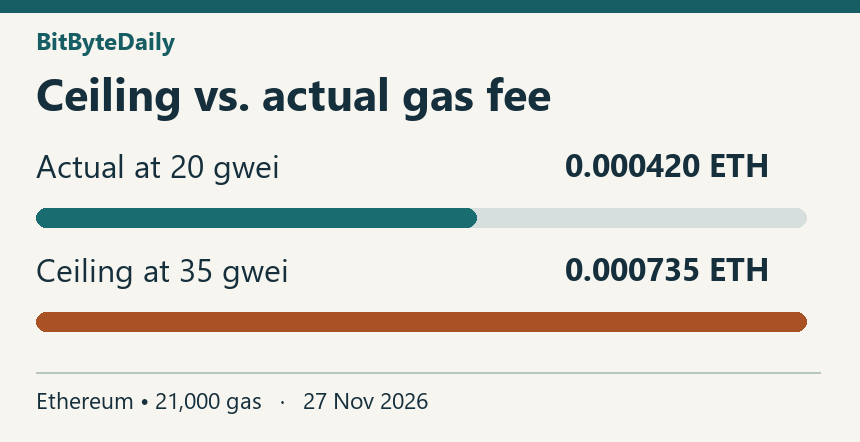
Suppose an ordinary mainnet transfer sends ETH to an account without code, carries no extra data, and uses 21,000 units of gas. The block's base fee is 18 gwei and the effective tip is 2 gwei per unit. Multiply 21,000 by 20. The result is 420,000 gwei. Divide by one billion to convert gwei into ETH.
Of that total, 0.000378 ETH is the base-fee portion burned under Ethereum's fee rules. The remaining 0.000042 ETH is the priority fee. If you sent 0.20 ETH, the recipient gets 0.20 ETH. With the fee, the example reduces your own balance by 0.20042 ETH.
Why a wallet might show 0.000735 ETH
Using the same gas limit, imagine you permit a maximum of 35 gwei per unit. That makes the fee ceiling 21,000 × 35 gwei, or 0.000735 ETH. It allows room for a different base fee when the payment reaches a block. If the effective price remains 20 gwei at inclusion, the receipt still records 0.00042 ETH. The difference of 0.000315 ETH is unused allowance, not another payment someone must send back.
A token transfer or swap invokes contract code and can use more gas. Do not reuse the 21,000 assumption for those operations. Also distinguish a wallet rejecting a request before broadcast from a transaction executed on-chain that reverts. The latter can consume gas even though the intended token transfer or swap never completes.
| Field | Example value |
|---|---|
| Gas used | 21,000 units |
| Effective gas price | 18 gwei base plus 2 gwei tip |
| Actual fee | 420,000 gwei, or 0.00042 ETH |
| Maximum at 35 gwei per unit | 0.000735 ETH for a gas limit of 21,000 |
Related reading: Crypto wallet tracker: reconcile a missing balance, Multi-chain crypto wallets: one address, two balances.
Questions & answers
Can I calculate a token swap fee from the dollar amount traded?
The size of the trade does not tell you how much computation it needs. Use the wallet's estimate for that particular execution and the receipt afterward.
Does this example apply unchanged on every Ethereum layer 2?
No. A layer 2 can include other cost components. Use that network's fee breakdown when checking a layer 2 payment.
Who receives the base fee and tip?
Ethereum burns the base-fee portion. The priority fee goes to the validator. Both are included in the effective gas price on the receipt.
Sources & update notes
Source review: 27 Nov 2026. Public documentation and illustrative examples. No transaction was made for this article.
- Ethereum gas units, base fees and effective tips
Official documentation checked 27 November 2026.
- Ethereum transactions and execution
Official documentation checked 27 November 2026.
What changed
First edition with a worked example and editorial diagram.
Find more explanations in the practical crypto guides.
Explore the full archive, or read how this edition handles historical coverage.