

Follow the balance, not the letters
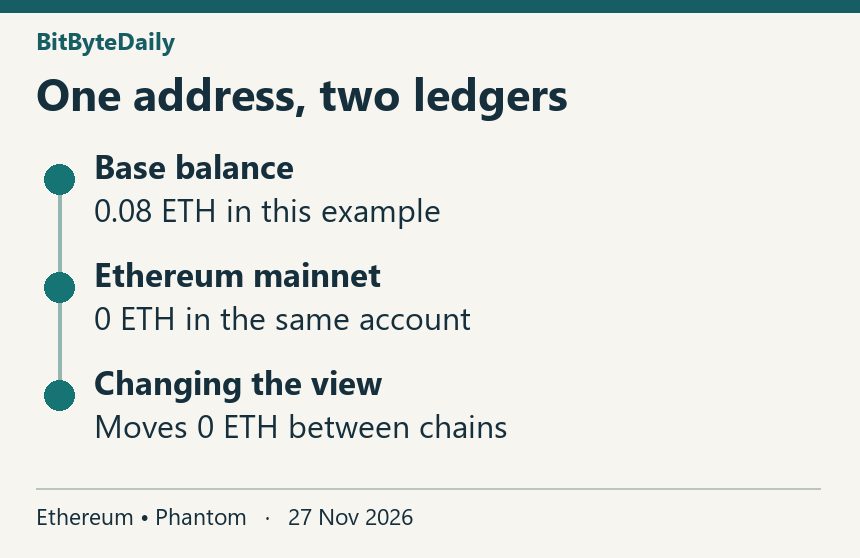
Imagine a self-custody account has 0.08 ETH on Base and zero on Ethereum mainnet. Its owner opens an application configured for Ethereum and gets an insufficient-funds message. Both screens can be right. The application is asking the Ethereum network whether this account can fund the transaction there. It cannot spend the ETH recorded on Base.
Start by finding the original receipt on the network named by the sender. Match the destination to the intended account. Then ask what you want to do next. If you only need to view the transfer, enable or select the network in a wallet that supports it. Viewing a balance requires no trade or bridge.
When moving between networks serves a purpose
If the destination application also runs on Base and accepts the asset you hold there, using that deployment may accomplish the task without moving funds. Verify the application's own supported network and asset first. Identical ticker symbols can identify different token contracts, even on the same chain.
If the recipient accepts only Ethereum mainnet, pick a route whose output explicitly names that network and the right asset. A bridge introduces its own assumptions and charges. Inspect the expected amount received, any separate claim step and the network needed for that claim. For a deposit to a service, use the deposit routes it lists. Do not assume the service will support a bridged token just because its address begins with 0x.
| Goal | What changes |
|---|---|
| See an existing Base balance | Selecting Base changes the view only. |
| Use an app on Base | The transaction executes there if the app supports the asset. |
| Deliver to Ethereum mainnet | A supported cross-network route must actually deliver the asset to mainnet. |
Related reading: Phantom crypto wallet: find a missing deposit, Crypto gas fees: read an Ethereum receipt.
Questions & answers
Does adding a network cost gas?
Displaying a network in a wallet does not itself broadcast a payment. Signing a transaction to move assets is a separate action.
Can I reuse an address for every chain?
Check the receive screen for that account and network. Some networks share address formats, while others use entirely different formats.
Will ETH on Base cover a mainnet fee?
An Ethereum mainnet transaction needs funds on mainnet. Having ETH on Base at the same address does not give the mainnet account a balance.
Sources & update notes
Source review: 27 Nov 2026. Public documentation and illustrative examples. No transaction was made for this article.
- How a wallet organizes networks and addresses
Official documentation checked 27 November 2026.
- Ethereum's guide to bridge types and risks
Official documentation checked 27 November 2026.
What changed
First edition with a worked example and editorial diagram.
Find more explanations in the practical crypto guides.
Explore the full archive, or read how this edition handles historical coverage.