

Why older articles describe a spread
Fidelity's trading-fee documentation says records for trades before 4 December 2025 did not show a separate fee because the 1% was included in the price as a spread. Its current explanation treats the fee separately from the execution price.
That distinction matters when checking an old confirmation against a new one. An absent fee line in an older record is not proof that the trade had no cost. Equally, adding another assumed 1% spread to today's stated fee would misrepresent the documented model.
Work out the purchase before comparing providers
Let the executed market value be V and the fee rate be 0.01. A purchase charged on top of that value costs V × 1.01. For a fixed all-in budget B, the corresponding executed value is B ÷ 1.01.
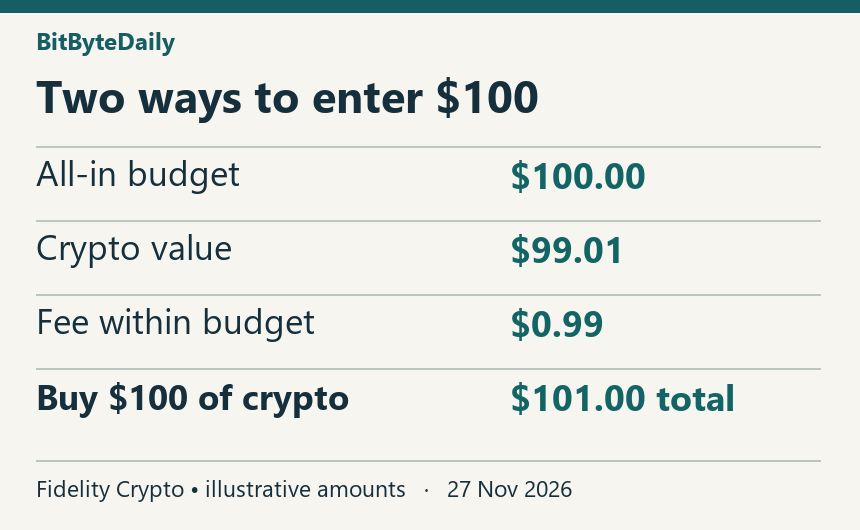
| Illustrative purchase instruction | Crypto market value | Trading fee |
|---|---|---|
| Spend $100 including the fee | $99.01 | $0.99 |
| Spend $1,000 including the fee | $990.10 | $9.90 |
| Buy $1,000 of crypto before the fee | $1,000.00 | $10.00 |
The last row requires $1,010 in total. These are our rounded calculations using the published rate, not live orders. All three assume the fee applies and ignore subsequent market movement or unrelated account charges.
The easy mistake is to compare a $1,000 all-in order on one platform with a $1,000 pre-fee order elsewhere. Use the same total debit, asset and measurement time. Then compare the resulting crypto quantity.
Selling creates another fee calculation
For a sale specified in crypto quantity, suppose the coins execute for $800 before fees. A 1% fee is $8, leaving $792. A sale at $1,200 produces a $12 fee and $1,188 after that charge.
These examples illustrate why the dollar fee is not fixed at the amount you paid on purchase. The selling price and quantity determine the executed value. A price gain, loss or unchanged market price is a separate issue from the fee.
At a hypothetical unchanged price, buying $1,000 of crypto before fees and selling the same quantity produces $20 of total trading fees: $10 on each side. That does not mean every round trip costs exactly 2% of the initial cash budget; the denominator and later execution value matter.
Keep account and product boundaries visible
Fidelity directs Wealth Managers customers to their own agreement and intermediary. Do not apply the retail schedule to every Fidelity-labelled service. Nor does a trading-fee statement establish which coins, transfers or account types are available to a particular reader.
Before choosing where to transact, identify whether you want direct ownership in a crypto account, exposure through a security, or a subsequent transfer to another wallet. Those are different outcomes. For the last one, compare the complete purchase-and-transfer path using the method in our exchange-cost guide.
Before you compare a purchase followed by a wallet transfer, check which account you hold. Fidelity says its Crypto IRAs do not support crypto deposits or withdrawals. An eligible Fidelity Crypto account can show a separate network fee at the review step. For a transfer, use the app’s Deposit/Withdraw crypto menu, choose Withdraw crypto and review the amount that will reach your wallet. Fidelity’s withdrawal instructions.
This is a documentation-based explanation with original arithmetic. We did not place a Fidelity trade or verify an individual account's eligibility.
Related reading: Robinhood crypto fees: routing and rates, Venmo crypto fees on a $100 purchase.
Questions & answers
Does Fidelity charge the fee on both buys and sells?
The published direct-crypto schedule applies to both. Calculate each transaction on its own executed market value.
Is the fee exactly $1 when I spend $100?
Not for a $100 all-in purchase under the documented calculation. The crypto value and fee together fit the budget, producing about $0.99 in fees after rounding.
Does the 1% rate apply to a Fidelity Bitcoin ETF?
This article covers Fidelity Crypto accounts. It does not establish the expenses, spreads or brokerage costs of any ETF; those require that security's own documents.
Sources & update notes
Source review: 27 Nov 2026. Public provider documents and our own illustrative arithmetic. No trade, transfer or account eligibility test. These are ordinary source links, not affiliate links.
- trading-fee documentation
Official documentation read 27 October 2026. No account-level quote or transaction test.
What changed
First guide edition, based on the approved manuscript and a fresh source check.
Find more explanations in the practical crypto guides.
Explore the full archive, or read how this edition handles historical coverage.