

Start with the trading route
Robinhood distinguishes market-maker routing from exchange routing. Its routing explanation says compensation from market makers is reflected in the spread. Compare actual quotes rather than adding a guessed spread to a commission-free order.
The standard fee PDF lists these exchange-routing bands:
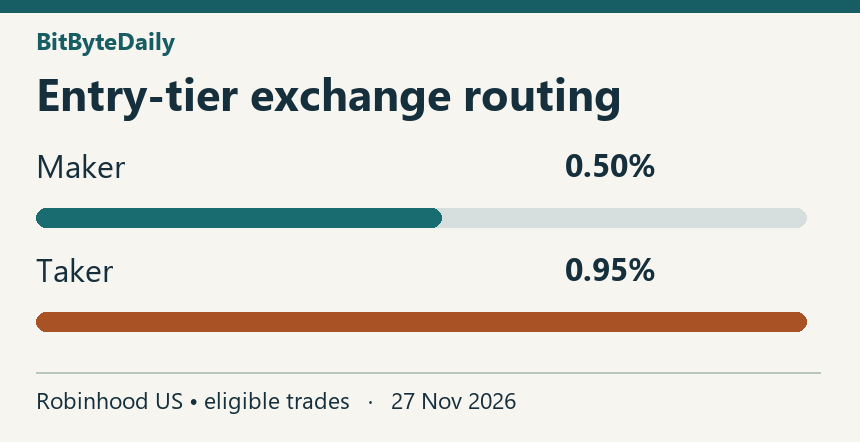
| Eligible 30-day volume, as labelled in the PDF | Standard / taker | Reduced / maker |
|---|---|---|
| $0–$10,000 | 0.95% | 0.50% |
| $10,000–$50,000 | 0.75% | 0.35% |
| $50,000–$250,000 | 0.25% | 0.125% |
| $250,000–$500,000 | 0.15% | 0.075% |
| $500,000–$1 million | 0.125% | 0.06% |
| $1–$5 million | 0.10% | 0.04% |
| $5–$10 million | 0.04% | 0.02% |
| $10–$25 million | 0.03% | 0.01% |
| $25 million and above | 0.03% | 0.00% |
This is the schedule bearing reference 20261102-6078699-19354665, read on 27 November 2026. At a shared band boundary, use the tier assigned in your account. Use the current order preview for the final charge and any rounding.
Why the fee preview can differ
The fee-tier help page describes a gradual maker/taker rollout and says customers may see different structures during it. An immediately executed limit order can pay a taker fee. Calling an order “limit” does not secure maker pricing.
The current PDF now includes both maker and taker columns, while the help page still warns about a gradual rollout. We do not treat the table as a quote for every account. Record the route, displayed fee and order type together when comparing an offer. Do not assume a lower rate shown in someone else's screenshot applies to your account.
A $100 trade and a $100 budget are different
Suppose $100 of crypto actually trades at the entry-level taker rate. Multiplying $100 by 0.0095 gives a $0.95 fee. An order entered against a fixed cash balance adds a wrinkle: before the order fills, the app cannot know which part will earn the lower maker rate.
Robinhood gives a $1,000 limit-buy example. It sets aside $9.50 when sizing the order, leaving $990.50 for crypto. If the order earns the reduced rate, the fee comes to about $4.95 and about $4.55 returns to buying power. Check your own rate under Account → Settings → Crypto → Fee tiers.
Include the cost of moving the coins
The standard schedule lists no Robinhood transfer charge but says network fees still apply. If your goal is self-custody, compare the amount reaching the destination after that transfer. A trading saving of $0.50 can be outweighed by a $2 difference in withdrawal costs.
Keep the destination network consistent. Receiving an asset on a different network is not automatically an equivalent outcome. Our exchange-cost comparison explains how to compare full cash cost with the amount delivered, using explicitly hypothetical examples.
This guide concerns US Robinhood Crypto documentation. It does not describe EU stock tokens, futures or Robinhood Wallet swaps. No account-level trade or withdrawal was performed for this article.
Related reading: Venmo crypto fees on a $100 purchase, Fidelity crypto fees: the 1% calculation.
Questions & answers
Is Robinhood crypto trading free?
Market-maker routing has no commission in the cited schedule. Its price can still reflect a spread, and an external transfer can have a network fee. Exchange routing has its own fee structure.
Does every crypto trade improve my fee tier?
Robinhood's fee-tier documentation distinguishes eligible exchange-routed volume from market-maker orders. Check the eligible volume displayed in your account rather than using all activity as the denominator.
Should I trade more to reach a cheaper tier?
A lower percentage does not erase the fees and market risk incurred by additional trades. Calculate the cost of the transaction you actually intend to make; a tier threshold is not a reason to increase trading.
Sources & update notes
Source review: 27 Nov 2026. Public provider documents and our own illustrative arithmetic. No trade, transfer or account eligibility test. These are ordinary source links, not affiliate links.
- routing explanation
Official documentation read 27 October 2026. No account-level quote or transaction test.
- standard fee PDF
Official documentation read 27 October 2026. No account-level quote or transaction test.
- fee-tier help page
Official documentation read 27 October 2026. No account-level quote or transaction test.
What changed
First guide edition. The earlier draft was corrected to the current two-column Robinhood fee schedule before integration.
Find more explanations in the practical crypto guides.
Explore the full archive, or read how this edition handles historical coverage.