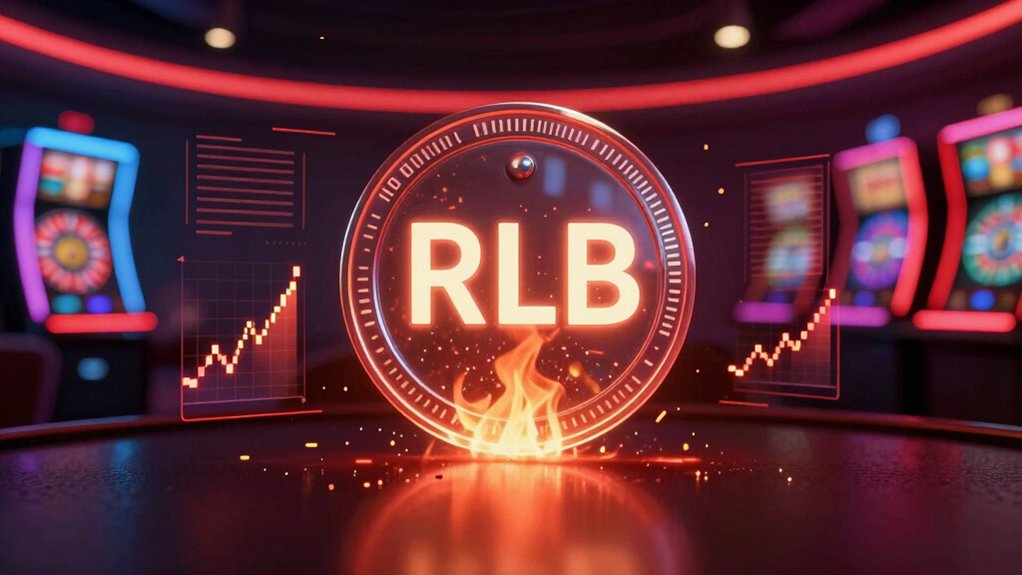
How has Rollbit’s recent deflationary strategy materially altered the supply dynamics of its native token, RLB? Since the August 2023 implementation of an automated Buy & Burn mechanism, Rollbit has markedly intensified its efforts to curtail circulating token availability, deploying a systematic allocation of platform-derived revenues—specifically 10% from casino, 20% from sportsbook, and 30% from futures operations—to execute hourly on-chain repurchases of RLB via the Degen Exchange. This ongoing process channels approximately 90% of acquired tokens into a verifiable burn address, effectively excising them from the total supply, while the residual portion incentivizes Rollbot stakers, thereby engendering a structural deflationary impact that actively contradicts prevalent inflationary tendencies traditionally embedded within similar utility token economies. The actualized magnitude of supply diminution, with multiple independent analyses converging on a figure approximating a 60% reduction from the initial 5 billion token cap, has recalibrated the tokenomics debate by empirically substantiating the extent to which engineered burn protocols can materially enfeeble token inflation and potentially enhance scarcity-driven valuation paradigms. Introduced on November 10, 2021, RLB was originally designed as a deflationary, utility-focused token. Additionally, Rollbot stakers receive 10% of the hourly Buy and Burn proceeds, further aligning incentives to support long-term token scarcity through staking rewards. This mechanism leverages smart contracts to automate the buyback and burn process without manual intervention.
Historically, the token’s supply contraction trajectory commenced with documented large burns beginning in January 2022, progressively diminishing the circulating quantity with subsequent staged burns publicly disclosed by Rollbit through precise transaction IDs and cumulative percentage updates, such as milestones reflecting reductions of 12.91%, 34.06%, and 35.51% prior to the more recent automation. These disclosures, augmented by on-chain transparency, underpin verified quantifications that substantiate the credibility of the deflationary strategy while also fostering external scrutiny. Nevertheless, nuanced discrepancies among third-party data sources—attributable to divergent cut-off temporalities and methodological variances in accounting for staked versus definitively burned tokens—complicate the establishment of an exact figure, albeit without undermining consensus on substantial net supply contraction. Additionally, the RLB Lottery, launched on November 25, 2021, has functioned as a significant demand driver through its burn collection and staking incentives. The entire process operates within a decentralized ecosystem, ensuring transparency and user control over asset flows.
Consequently, the deflationary impact achieved through this buyback and burn framework invites broader considerations within tokenomics discourse, particularly regarding sustainable supply modulation mechanisms and their efficacy in balancing utility-driven issuance against investor expectations for scarcity and price appreciation. Such analyses necessitate a critical appraisal of whether Rollbit’s model sufficiently mitigates inflationary pressures endemic to decentralized gaming tokens, or if future adjustments in revenue allocation and burn cadence will be requisite to preserve deflationary momentum in volatile market conditions.