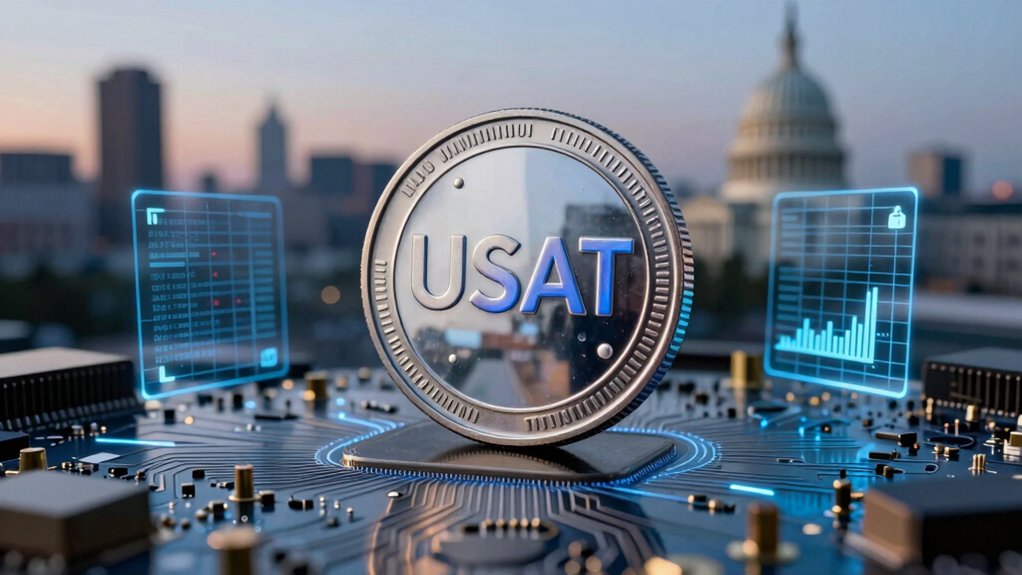

How does the advent of the USAT stablecoin, inaugurated by Tether under the auspices of the GENIUS Act, signify a transformative juncture in the United States’ digital currency landscape by integrating stringent federally mandated compliance frameworks with institutional-grade financial infrastructures, thereby fostering regulatory clarity, fortifying consumer protections, and catalyzing the broader adoption of a digital dollar ecosystem that simultaneously upholds the supremacy of the U.S. dollar as a global reserve asset while delineating a rigorous, transparent reserve backing and governance model indispensable for fostering confidence among banks, fintech entities, and regulated market participants within a rapidly evolving digital finance paradigm? The issuance of USAT by Anchorage Digital Bank, N.A., as the first federally regulated stablecoin issuer governed by the pioneering GENIUS Act, introduces a paradigm wherein compliance is embedded at the structural core—encompassing monthly audits, explicit reserve requirements consisting of one-to-one U.S. dollar backing and liquid government securities, thorough anti-money laundering protocols, and stringent penalties enforceable by federal regulators—thereby mitigating historical privacy risks that have shadowed decentralized or lightly regulated digital currencies, while simultaneously delineating a reservoir of liquidity that is both transparent and resilient against market fluctuations inherent in stablecoin operations. This framework includes monthly audits conducted by registered public accounting firms to ensure full reserve transparency and regulatory compliance. It aligns with the GENIUS Act’s goal of bringing long-awaited regulatory certainty to stablecoins, providing institutional actors with clear legal guidelines under U.S. federal law.
The intricate balance between enhancing privacy safeguards and preserving liquidity efficacy reflects the GENIUS Act’s nuanced regulatory architecture, which not only mandates full disclosure and auditability but also calibrates reserve compositions to guarantee seamless convertibility and transactional fluidity, thereby preempting systemic liquidity shocks that might arise from speculative runs or compromised custodial frameworks. This dual emphasis reassures institutional actors who demand robust operational transparency without sacrificing transactional privacy beyond regulated thresholds, fostering augmented market participation by U.S.-licensed banks, fintech companies, and exchanges, whose confidence is predicated on verifiable security and legal certainty. Additionally, by embedding these regulatory innovations into USAT—a digital dollar designed expressly for demanding institutional use cases and fully compliant with the United States’ most rigorous federal stablecoin statutes—there emerges a scalable infrastructure that interlinks traditional financial ecosystems with blockchain’s immutable ledger capabilities, thereby heightening the digital dollar’s penetration into mainstream financial services while reinforcing the U.S. dollar’s hegemonic status in both on-chain and off-chain financial domains.
Consequently, USAT’s launch not only mitigates systemic privacy vulnerabilities by tethering transparency requirements with consumer protections under federal oversight, but also undergirds the stablecoin’s liquidity robustness through rigorous capital and reserve management, thereby accelerating the United States’ digital finance maturation and signaling a substantive shift towards a regulated, institutionally credible, and technologically advanced digital currency framework that addresses and balances the complexities of privacy concerns and liquidity imperatives in tandem.